Skip to content
OpAgent in Motion

One encounter, from the clinic day to the paid claim.

Three short films and the loop that closes them. No narration. The physician, the surgical coordinator and the biller, working the same case inside the systems they already use, and the practice seeing what it earned.

Scroll
01 · The clinic day · 58 s

OpAgent inside athenaOne.

The morning roster reads itself. RadiologiQ, Bone Health and Clinical Optimization surface only where something is due; the physician approves, and it lands in the chart.
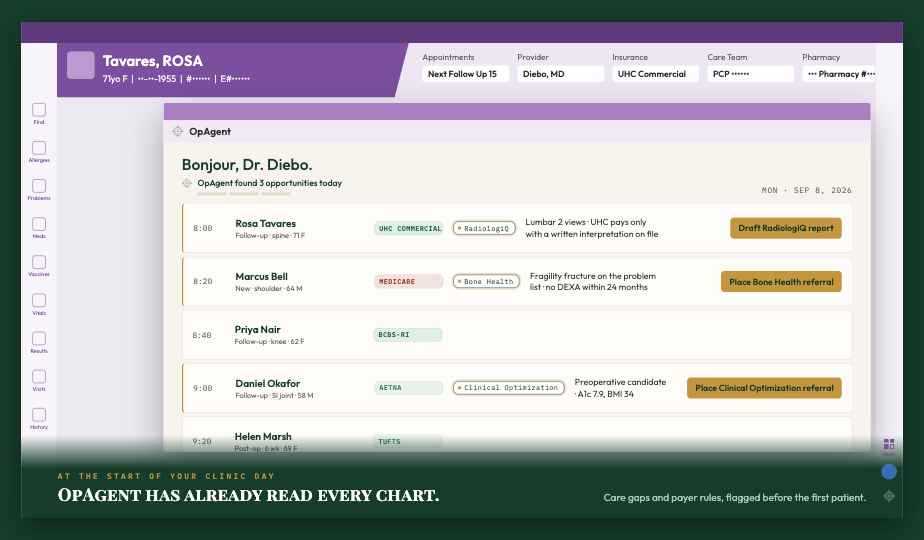
RadiologiQAvailableBone HealthControlled rolloutClinical OptimizationControlled rollout
What one orthopedic group found in its own books

A decade of records, reconciled to the cent, before a single agent was built.

1.07Mpatients
4.2Mclaims
41.9Mtransactions
3,374payer letters, read into requirements
Surgical denials rose about five points in one year.Seven years flat, then 2025. Same surgeons, same operations. Documentation reasons led; coding barely registered.
Documentation-supported coding variance in about half of sampled level-3 encounters.Retrospective review of signed notes against the level billed. Modeled opportunity, not collected revenue; no encounter was re-billed.
The same $10,000 costs up to five times more to collect from one payer than another.Denial rate is not the cost. Handling is: resubmissions, records requests, phone time.
Design-partner practice, unnamed. Rounded figures from a source-reconciled ledger; every rate has a numerator, denominator and period on file. Patient and claim counts are all-history populations, not claim-connected subsets, and are reconciled against the current ledger before each publication. Modeled figures are labeled modeled. No patient-level data.
02 · The full encounter · 80 s

The physician finishes the visit once.

Listen, dictate, or use the note already in the chart. OpAgent drafts, checks the documentation, codes from the final note with the evidence beside each code, and hands a defined case to the coordinator. Nothing files without the physician.
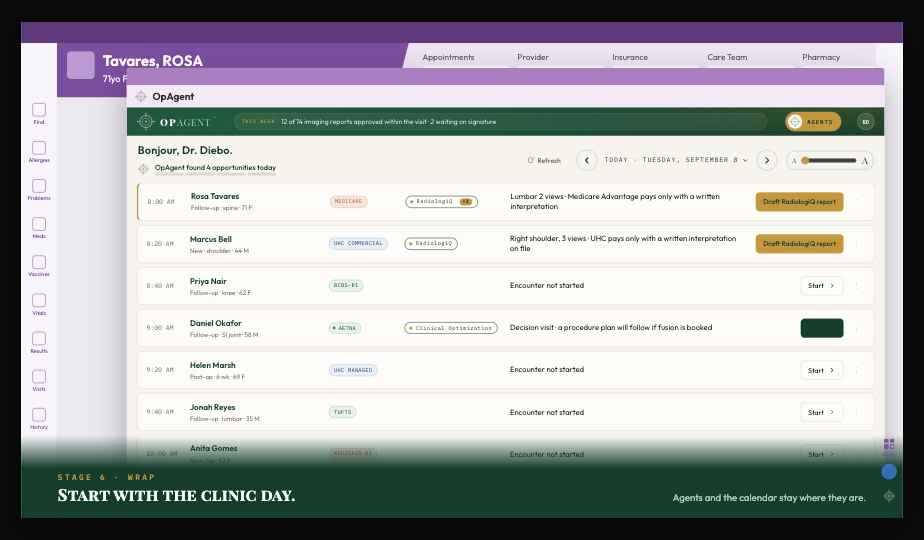
WrapIn developmentNoteIQIn validationVisit codingIn validation
03 · The surgical case · 65 s

Op Note & Coding.

One case ledger for surgeon and biller: the operative note drafted before the case, codes checked against what was performed, and every claim watched after it leaves.
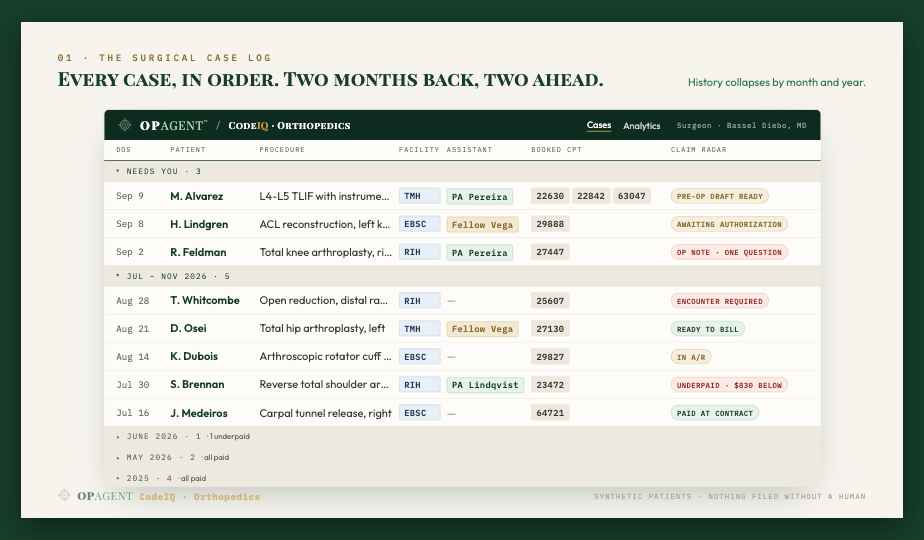
Op Note & CodingIn validationClaim RadarIn development
04 · The economic loop

CQO closes the loop.

The claim leaves the practice. What comes back is read, not filed: earned, delayed, denied or underpaid. The supported next action is prepared for a person, and what was learned reaches the next encounter before it starts.

CQOIn developmentClaim RadarIn developmentReQoverIn development
1Claim leavesSubmitted with the operative record, the codes and the evidence behind them.
2Payer answersRemittance, records request, or denial. Every line, every day, read against contract.
3CQO accountsEarned at contract, delayed, denied, or paid below. By payer, procedure, surgeon and month.
4Next action, preparedClaim Radar flags it; ReQover drafts the supported resubmission or appeal. A biller decides.
5Next encounter, betterWhat this payer required, and what it did, reaches the Brief before the next visit begins.

Start with your own books.

A time-bounded, read-only analysis of your historical data. A written map of where the money leaks and where the opportunity is. Then you decide.

We only use this to reply to you.